

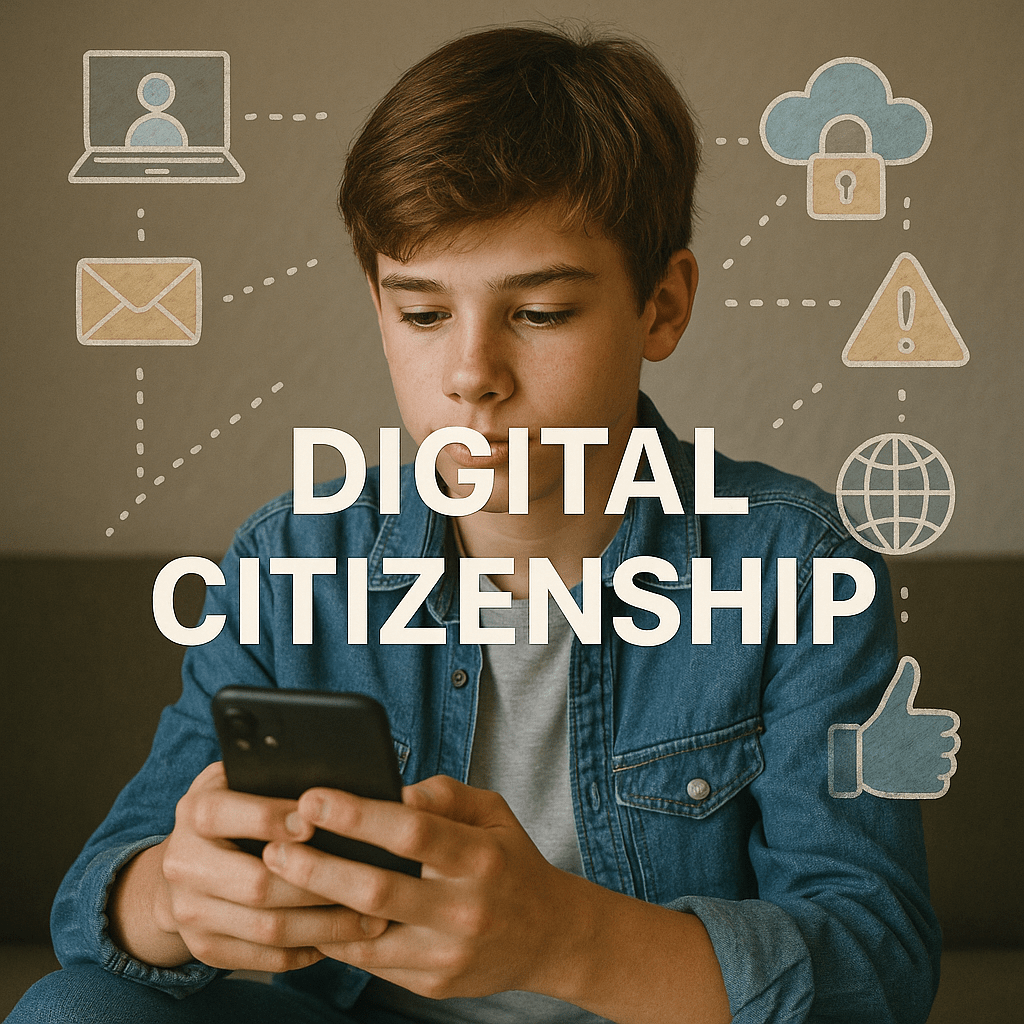
Having recently met with colleagues looking at Digital Citizenship Education this encouraged me to scribble together some thoughts, which form the below post. I believe, now more than ever, we need to re-examine our education system especially as it relates to digital citizenship and preparing our students for the digital world we now live in, and for the digital world of the future, whatever that might look like.
For years, educators have spoken about “digital” citizenship as if it were a distinct concept, something separate from the so-called “real” world, and real world citizenship. But that separation no longer exists. Today, digital systems underpin almost every aspect of daily life: banking, healthcare, travel, shopping, and even social interaction. When these systems fail, life grinds to a halt. You just need to look at the Crowdstrike incident and the more recent AWS issues to see this. Any separation between the digital and the real worlds which may have existed in the past, no longer exists.
This raises an important question: does the term digital citizenship still add value? I don’t think it does. Instead, we need to think about citizenship in a connected world; a world where artificial intelligence (AI), automation, and global networks shape how we live, work, and relate to one another. The challenge is not simply about teaching children how to behave online; it is about preparing them for a society where technology mediates almost every interaction. It’s also about preparing them for a future world where the technologies of today will have been replaced by new technologies, some we can predict and others that may not currently be as evident.
But this digital or technological change isn’t new to discussion of citizenship. Citizenship education has never been static. It has always evolved in response to societal forces. In early modern Europe, it sought to counter superstition and establish rational norms. In the twentieth century, it became a bulwark against fascism and communism, promoting democratic values and civic responsibility. Today, the forces shaping citizenship education are different but no less profound. We face questions about identity and belonging in a globalised world, the ethical implications of AI, and the fragility of truth in an era of misinformation and disinformation. Privacy is also an issue, or construct, which is now under question as we are faced with a world where people wander the streets with AI powered smart glasses and other wearables on, constantly recording, cataloguing, summarising and recommending our every action. These are not abstract concerns; they affect how societies cohere and how individuals navigate their rights and responsibilities.
As I think about this I wonder about a fundamental tension: do we teach for a global society or at national level, reinforcing national norms? Should education prepare young people to embrace diversity and shared human values, or should it prioritise national identity and social cohesion? This is not a trivial question. It touches on debates about migration, climate change, and international governance. It also exposes the political nature of citizenship education. What we choose to teach and what we choose to omit reflects the kind of society we want to build. These decisions are made at national levels, albeit contain some reference to globalisation.
Layered on top of these questions is the reality of AI and algorithmic decision-making. Increasingly, decisions that affect our lives including credit approvals, job applications, even court outcomes are mediated by algorithms. The news, even on trusted news platforms, are influenced by the swathes of data and content generated on social media. AI tools further complicating things in enabling the generation of fake content which makes it increasingly difficult to discern the truth and whether something presented as true is actually true or if something presented as false, is actually false. Understanding how these systems work, and their potential biases, is essential for informed citizenship. Without this knowledge, individuals risk becoming passive subjects of technology rather than active participants in shaping its use.
Then there is the problem of information disorder, of misinformation and disinformation. Deepfakes, misinformation, and polarised media ecosystems challenge the very notion of truth. If citizenship education once focused on teaching civic literacy, it now must teach epistemic resilience in the ability to question sources, verify facts, and resist manipulation. In a world where AI can generate convincing falsehoods at scale, this skill is not optional; it is foundational.
So, what should citizenship education look like in this context? It cannot be reduced to a checklist of technical skills. It must cultivate critical thinking and not just the ability to analyse arguments, but to interrogate algorithms, question data, and understand the socio-technical systems shaping our lives. More than ever we need to not just question what we see and hear, but also the why; Why an algorithm has chosen to present this content over other content and what this might mean. It must emphasise human skills such as empathy, collaboration, and adaptability, qualities that machines cannot replicate but which are vital for social cohesion and ethical decision-making. It must foster ethical literacy, enabling students to grapple with questions of fairness, privacy, and accountability in AI systems. And it must build resilience, preparing young people to cope with uncertainty and change in a world where disruption is the norm.
Citizenship education in the age of AI is not about adding a few lessons on online safety or digital etiquette. It is about rethinking what it means to live responsibly and ethically in a world where technology mediates almost every interaction. Educators, policymakers, and communities must ask hard questions: what values do we want to uphold in a connected world? How do we balance global responsibilities with local identities? How do we ensure that technology serves humanity, rather than the other way around? What does it mean to flourish in a technological world and how do we support our students to flourish?
The answers will shape not just curricula, but the future of democracy itself. Citizenship education has always been about preparing young people for the world they will inherit. Today, that world is algorithmic, interconnected, and uncertain. Our task is to ensure they enter it not as passive users, but as active, ethical citizens. And this all requires that we start thinking deeper, asking more probing questions and supporting and encouraging our students to do the same.

 Technology and Learning