
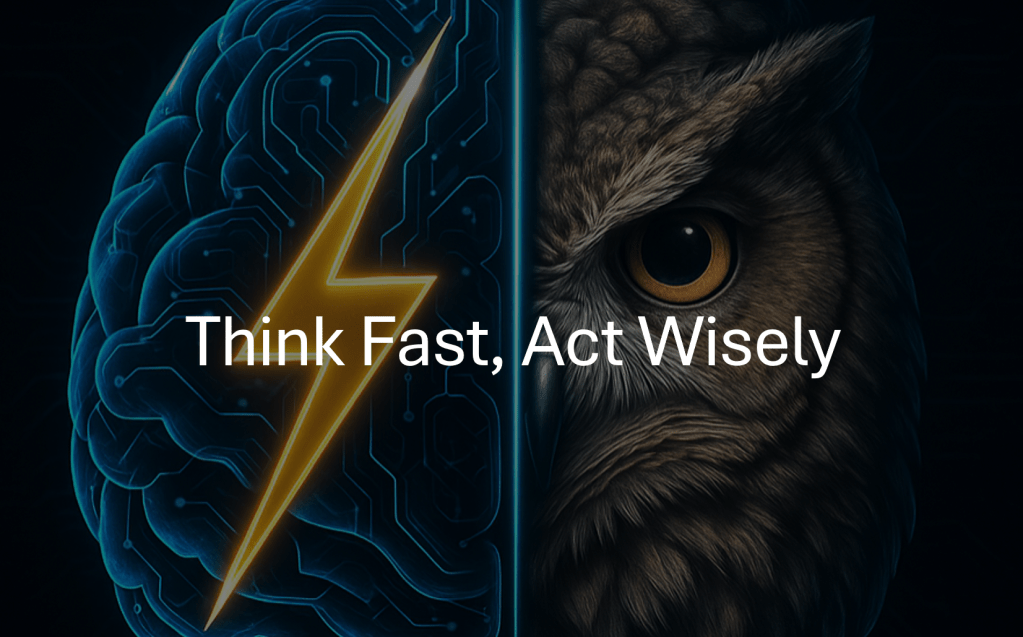
I recently gave a presentation titled “think fast, act wisely” at the Berkhamsted IT Conference looking at the future of education as I see it. Below are my key thoughts as presented at the conference.
The landscape of education has always been shaped by the tools at its disposal. In 1998, when I entered the teaching profession as a fresh faced, and very young looking newly qualified teacher, the classrooms I worked in were dominated by blackboards and chalk. I still remember dusting myself off each day having leant on the board as I was writing things. The late 1990s and early 2000s saw the first technological shifts, but the pace of technological change has only accelerated since then. As we stand on the brink of increasingly frequent breakthroughs in artificial intelligence (AI), quantum computing, AI use in medicine and even bioengineering, it’s clear that technology is transforming our world. Yet, education often lags, moving at a much slower, incremental pace.
The Slow March of Educational Change
Despite the rapid evolution of technology, the structure of education remains stubbornly familiar. Promises of transformation have been plentiful, but delivery has been inconsistent. Interactive whiteboards, virtual learning environments (VLEs), flipped learning, MOOCs, and 1:1 device programs have all brought benefits, but rarely have they redefined learning in a fundamental way. The SAMR model has presented a way of examining our tech integration in schools, however time after time we have been stuck at substitution, never progressing to the potential of augmentation, modification or redefinition. The IWB for example simply replacing the whiteboard which had previously replaced the blackboard, or the 1:1 device, often being little more than a replacement for the textbook and workbook.
The barriers to the potential of tech are not just technical but human, including insufficient training, resistance to change, or processes that fail to adapt. Sometimes, the technology itself falls short particularly in relation to the sales promises when compared with pragmatic tech use in real life classrooms. If there has been some meaningful progress, as I believe there has been in the last 5 years, it has been the result of significant external forces, like the COVID-19 pandemic. I personally saw the potential here, with one student in particular who struggled in the classroom but thrived engaging remotely via Teams. The issue here was that this progress was not sustained, and there was a “rubber band effect,” snapping back to old habits once in-person learning resumed.
Artificial Intelligence: Promise and Peril
The arrival of AI in education marks a new chapter, and another external factor impacting on education. Tools like ChatGPT have democratized creativity and output, allowing students of all abilities to produce impressive work. AI can also assist teachers with content creation, marking, and summarizing, freeing up time for deeper engagement. However, these advances come with significant risks: ethical concerns, bias, accuracy, and the potential for disinformation. The binary debate of block or allow misses the nuance required to navigate these challenges.
If education continues to move slowly, it risks falling behind. And as this occurs some users will simply seek to act on their own, using whatever tools they feel are of benefit. Shadow IT, where users, both staff and students, unofficially use technology solutions may then introduce safeguarding and cybersecurity risks. Also, the divide between those who embrace new tools and those who don’t will widen, exacerbating inequalities. Moving too fast, however, brings its own dangers. I, for example, worry of those chasing “shiny new things” without proper embedding, straining resources, and overlooking critical issues like data protection and AI ethics.
Striking the Right Balance
The key is balance. Every new technology brings a mix of risks and benefits, and schools must develop and understand their own risk appetite. Regulation and compliance are essential, and many look to centralized guidance for support however this is slow to arrive, often seeing publishing only after technology has already changed or moved on. It is therefore about considering the risks and about going much deeper than the block or allow narratives that often prevail. It is possible to find a middle ground blocking some things, while allowing others, accepting some risks, accepting the weakness of technical controls, but mitigating through education and also using mistakes people may make as an opportunity for learning rather than as situations that must be eradicated. We must think deeper.
For example, exam specifications warn against copying material and stress the importance of “own work.” But what does that mean in an age where AI tools are embedded in the learning process? If I use spell checker or grammar checker, or if I get AI to help start my document or to review the content and offer feedback; is it still my work? In thinking about this, if my teacher teaches me something, and I then use this knowledge to write a piece of coursework, if this my work? And why wouldn’t I want to use AI to review and help me improve my work; Don’t we want students to achieve their full potential, using the technologies which are available and will be available in their lives beyond the school? The phrase, “must be the students own work”, seems pretty straightforward however in a world of AI tools, where these tools are embedded in the productivity tools we want students to use, it may not be that simple. We must think deeper.
Rethinking the Purpose of School
This is a moment to reflect on the fundamental purpose of school. Do we need physical buildings? What do we want our schools to achieve, and how should technology help us get there? Values and progress are crucial as is accepting that change is inevitable. As such we need to become more agile and flexible to such change. But we are not alone. Through collaboration, discussion, and sharing we can collectively approach the challenges.
Big Questions for the Future
As we look ahead, a couple of big questions emerge:
- What does human flourishing look like, and how do we support students to thrive now and in the future?
- What is the purpose of education? How do we assess learning in a world shaped by AI, and what are we actually measuring?
- How can AI best support students, teachers and school leaders, freeing them to think deeply and creatively?
The answers require courage, pragmatism, and a willingness to adapt. The education sector has an opportunity to be brave, but this means learning to move faster, but also to act wisely, navigating the balance between these competing requirements. It is due to this that we need to get better at managing risk, and that includes actually establishing what the risk of harm is and taking crucial decisions in relation to allocated resources. We cant address every risk to the same extent.
Above all, we must remember that we are on a shared journey. In a world of AI, synthetic identities and AI assistants , it is collaboration, and human connection, that may be our greatest asset.

 Technology and Learning